 February 23, 2026
 11 min read
Convert education JPG to Excel technology is the cornerstone of modern educational digitization, allowing academic institutions to move away from stagnant paper records and toward dynamic digital assets. Schools are changing incredibly fast these days, with more materials shifting from physical folders to searchable computer files. Teachers and students now use a wide array of digital tools every morning to enhance the learning experience. However, a significant portion of valuable academic data—such as scanned grade books, printed research tables, and textbook snippets—remains trapped in simple picture formats. When information is stuck in a static image, it becomes functionally “invisible” to data analysis tools, creating a major hurdle for educators who need to track progress or analyze statistics.
To bridge this gap, you need a high-precision JPG converter education solution. While a standard JPG is easy to view on a screen, it is virtually impossible to edit or calculate. You cannot easily sort a list of student names or perform a mathematical sum of test scores inside a photo. This is where the ability to convert education JPG to Excel becomes a strategic advantage for any modern classroom. By transforming static pixels into organized rows and columns, educators can save thousands of hours previously lost to manual data entry.
Whether you are a student organizing a complex science project or a registrar managing OCR JPG school docs, this guide will show you the most efficient roadmap to data success.
What Does It Mean to Convert JPG to Excel for Education?
Why Static Images Are a Problem for Academic Data
A JPG file is a static image format that stores visual information as pixels, not as readable or editable text. When a teacher scans a grade book or a student photographs a data table from a textbook, the result is a picture of information, not the information itself. You cannot sort it, calculate with it, or search within it using any standard spreadsheet tool.
This creates a significant bottleneck in educational environments where data management is constant. Attendance records, standardized test scores, lab results, and research datasets all require analysis, not just review. A static image makes that analysis impossible without first converting the content into a structured format.
How OCR Technology Solves This Problem
Optical Character Recognition (OCR) is the technology that reads characters within an image and converts them into machine-readable, editable text. Unlike a basic scanner that simply photographs a page, an OCR engine interprets each letter, number, and symbol, then reconstructs the original table structure inside a spreadsheet.
Modern OCR tools go further than character recognition. They detect column boundaries, identify headers, and preserve merged cells, meaning your output spreadsheet mirrors the layout of the original document.
According to UNESCO’s data on education digitization, institutions that systematically digitize academic records report measurable improvements in data accessibility and administrative efficiency.
Why Teachers and Students Need JPG to Excel Conversion
Saving Time on Grade Book and Attendance Management
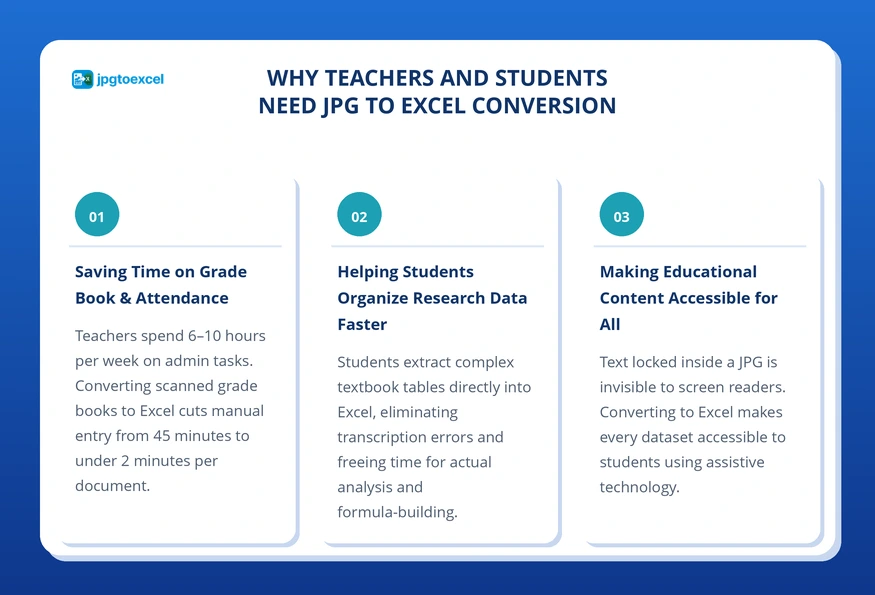
According to the OECD TALIS Survey, teachers in most countries spend between 6 and 10 hours per week on administrative tasks outside of teaching, including data entry, record updating, and report preparation. A significant share of that time is consumed by manually transcribing information from paper or image-based formats into digital systems.
When you convert a scanned grade book image to Excel, a process that once took 45 minutes of careful manual typing takes under two minutes. The resulting spreadsheet is immediately ready for sorting, averaging, conditional formatting, and sharing with department heads or parents.
Helping Students Organize Research Data Faster
For students working on science projects, economics assignments, or literature reviews, printed tables and charts are a constant source of friction. Photographing a data table from a textbook and trying to recreate it manually introduces transcription errors and wastes time that should go toward analysis.
By using a JPG to Excel converter, students can extract a complex dataset from a textbook photo in seconds, import it directly into their own spreadsheet models, and begin running formulas and building charts immediately. Accuracy improves and the research workflow accelerates significantly.
Making Educational Content Accessible for All Students
Standard screen reader software used by visually impaired students cannot parse text that is embedded inside a JPG image. The content is invisible to assistive technology, which means students who rely on these tools are effectively excluded from image-based materials.
When you convert educational images to Excel or other editable formats, the content becomes readable by screen readers, compatible with text-to-speech software, and navigable by keyboard. This is not just a productivity gain. It is a direct contribution to equal access in the classroom.
Step-by-Step: How to Convert Education JPG to Excel with OCR
Getting a clean, accurate output depends as much on input quality as it does on the tool you use. Follow this workflow to consistently achieve high-accuracy results with your school documents.
Step 1: Prepare Your Document for Scanning
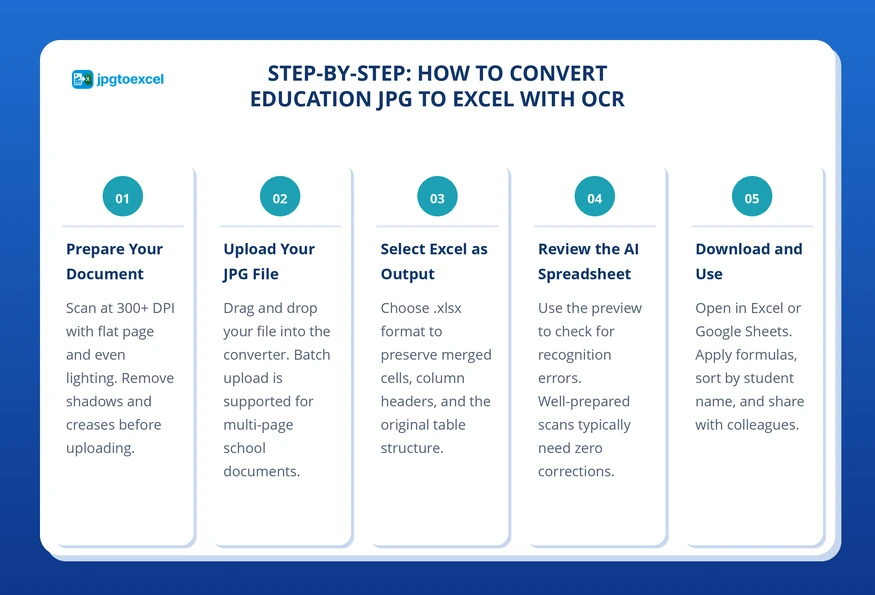
Scan or photograph your document at a minimum resolution of 300 DPI. This is the baseline at which OCR engines can reliably distinguish between similar characters such as “0” and “O” or “1” and “l”. Use even, diffused lighting to eliminate shadows, and make sure the page is completely flat. For thick textbooks, press the spine down firmly so the text near the binding does not curve away from the camera.
Step 2: Upload Your JPG File to the Converter
Go to jpgtoexcelconverter.com and drag your JPG file into the upload area. The platform supports batch uploads, so if you have multiple pages from the same grade book or report, you can process them all in one session. All files are handled with enterprise-grade encryption, which is essential when you are uploading student records or sensitive OCR school documents.
Step 3: Select Excel as Your Output Format
Choose .xlsx as your output format rather than .csv. Excel format preserves merged cells, column widths, and header formatting that .csv strips out. For educational documents with complex layouts such as multi-subject grade sheets or lab result tables, .xlsx gives you a much cleaner starting point. The converted file will also open directly in Google Sheets if your school uses Google Workspace.
Step 4: Review the AI-Generated Spreadsheet
Before downloading, use the preview panel to scan for any recognition errors. Pay particular attention to columns that contain numbers, as OCR occasionally misreads “8” as “3” or “6” as “0” in low-contrast scans. Check that headers are in the correct row and that no columns have been merged incorrectly. Most well-prepared scans require zero corrections at this stage.
Step 5: Download and Use in Your Workflow
Download the finished .xlsx file and open it in Microsoft Excel or Google Sheets. From here, you can apply formulas, build grade-average calculators, set up conditional formatting to flag failing scores, or share directly with colleagues and parents. The digitized file integrates immediately with any existing school data management system.
Real-World Use Cases Across Academic Departments
The ability to digitize image-based school documents delivers measurable value across every department, not just individual classrooms.
| Use Case | Who Benefits | Estimated Time Saved |
| Grade book digitization | Classroom teachers | 3 to 4 hours per week |
| Attendance sheet processing | Homeroom and admin staff | 2 hours per week |
| Lab data extraction from textbooks | STEM students | 1 to 2 hours per assignment |
| Enrollment and permission form processing | School office staff | 5+ hours per intake cycle |
| Research dataset extraction | College and high school students | 1 hour per source document |
STEM Classes: Extracting Lab Data and Textbook Tables
Science and mathematics students regularly encounter complex data tables in printed textbooks and research papers. Manually copying a 40-row experimental results table introduces errors that can invalidate an entire analysis. By converting the image directly to Excel, students can integrate the original data into their own models, run regressions, and generate accurate charts without a single transcription error.
Administrative Offices: Processing Enrollment and Permission Forms
School offices that handle student enrollment, field trip forms, or medical consent documents deal with high volumes of structured paper data every semester. Batch processing these forms through an OCR converter for school documents compresses what used to be a week of data entry into a single afternoon, with higher accuracy than manual input.
Research Students: Building Datasets from Printed Academic Sources
Graduate and undergraduate students frequently work with data published in printed journals or older digitized PDFs where the tables are saved as images. Converting these image-based tables into editable spreadsheets makes it possible to clean, merge, and analyze data across multiple sources, a workflow that is otherwise painfully slow when done by hand.
5 Tips to Get 99% Accuracy When Converting School Documents
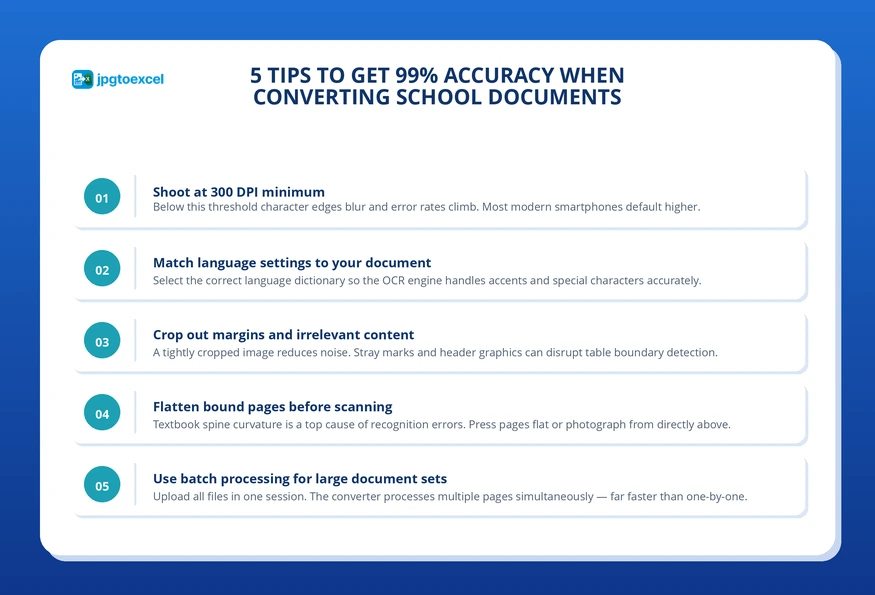
Input quality is the single biggest variable in OCR accuracy. The tool matters, but what you give it matters more.
- Shoot at 300 DPI minimum: Below this threshold, character edges become blurry and error rates climb sharply. Most modern smartphones default to higher resolutions, but double-check if you are using an older scanner.
- Match language settings to your document: If your school document includes accented characters, non-Latin scripts, or specialized academic notation, selecting the correct language in the converter settings allows the OCR engine to apply the right character dictionary. This is especially relevant for foreign language classes or international curricula.
- Crop out margins and irrelevant content: A tightly cropped image focused on the table or text area gives the OCR engine less noise to work through. Stray handwriting in margins, coffee stains, or header graphics can occasionally interfere with table boundary detection.
- Flatten bound pages before scanning: The text curvature near a textbook spine is one of the most common causes of recognition errors in student documents. Press the book as flat as possible, or photograph from directly above rather than at an angle.
- Use batch processing for large document sets: If you are digitizing an entire semester’s worth of attendance records or a full archive of student enrollment forms, batch upload all files in one session. com processes multiple files simultaneously, which is significantly faster than uploading and downloading individually.
Why jpgtoexcelconverter.com Is Built for Educational Digitization
jpgtoexcelconverter.com is an intelligent document processing platform designed to read and understand images with the same precision a trained data specialist would apply manually. The platform uses advanced Optical Character Recognition (OCR) technology to identify characters, numbers, and table structures within any visual file, going far beyond what a basic scanner can do.
A standard scanner creates a picture of your words. jpgtoexcelconverter.com actually interprets them. The engine reads each character, reconstructs the original table layout, and exports a clean, editable .xlsx file that is ready for formulas, sorting, and analysis the moment you download it. That distinction is what makes it a genuinely useful tool for teachers and students, not just a file format converter.
For educational institutions, the platform serves as a practical bridge between legacy paper archives and modern data workflows. It intelligently detects where a table starts and ends on a page, which is critical when processing multi-section grade books, printed attendance sheets, or scanned research tables with irregular formatting. School office staff can upload a stack of enrollment forms and receive structured spreadsheets without rebuilding a single row by hand.
Data privacy is built into the core of the platform. Student records are handled with enterprise-grade encryption throughout the upload, processing, and download processes. Files are not retained after your session ends, which keeps your school’s data practices aligned with standard institutional privacy requirements.
jpgtoexcelconverter.com also supports multi-language documents, so teachers running bilingual programs or students working with international research materials can process content in foreign languages without losing character accuracy. Whether you are digitizing a decade of archived report cards or extracting a single data table from a printed journal, the platform handles the complexity so you can focus on the work that actually matters.
Conclusion
The ability to convert JPG to Excel for education is no longer a technical specialty. It is a baseline productivity skill for any teacher or student working in a data-driven academic environment. Every scanned grade book, photographed textbook table, or printed research dataset that stays trapped in an image format represents hours of unnecessary manual work and a barrier to the kind of analysis that actually improves learning outcomes.
With a structured workflow and the right OCR tool, that conversion takes minutes, not hours, and the results are accurate enough to use immediately in real academic work.
Stop retyping. Start converting. Process your first school document at jpgtoexcelconverter.com and see how fast your classroom data can move.
FAQs: Converting JPG to Excel for Teachers and Students
How do I convert a JPG to Excel without retyping everything?
Upload your JPG to an OCR-powered tool like jpgtoexcelconverter.com, select Excel as the output format, and the AI will automatically detect table structures, recognize characters, and generate an editable spreadsheet. The entire process takes under two minutes for a standard school document, with no manual retyping required.
What is the best OCR tool for teachers converting school documents?
The best OCR tool for teachers is one that combines high table-detection accuracy with strong data privacy protections, since school documents often contain sensitive student information. jpgtoexcelconverter.com is built specifically for structured document extraction, supports batch uploads, and handles multi-language documents common in diverse academic environments.
Can I convert a scanned image to a spreadsheet accurately?
Yes, provided your scan is at least 300 DPI with good lighting and a flat page. Under these conditions, a quality OCR engine achieves accuracy rates above 99% for printed text. Handwritten content is more variable, but printed grade books, textbook tables, and typed school forms convert with very high precision.
How do teachers digitize paper grade books?
Teachers scan or photograph each grade book page at high resolution, then upload the images to an OCR converter that outputs Excel. The resulting spreadsheet replicates the original row-and-column structure, allowing teachers to immediately apply formulas, sort by student name, and calculate averages without rebuilding the table from scratch.
Is it safe to upload student records to an online converter?
Choose a converter that uses end-to-end encryption during upload and does not store your files beyond the processing session. jpgtoexcelconverter.com applies enterprise-grade encryption to all uploaded documents and does not retain files after download, making it appropriate for handling student records in compliance with standard school data privacy requirements.
- Email: contact@jpgtoexcelconverter.com
- LinkedIn: https://www.linkedin.com/in/jpgtoexcelconverter/
- X: https://x.com/jtoexcelconvert